




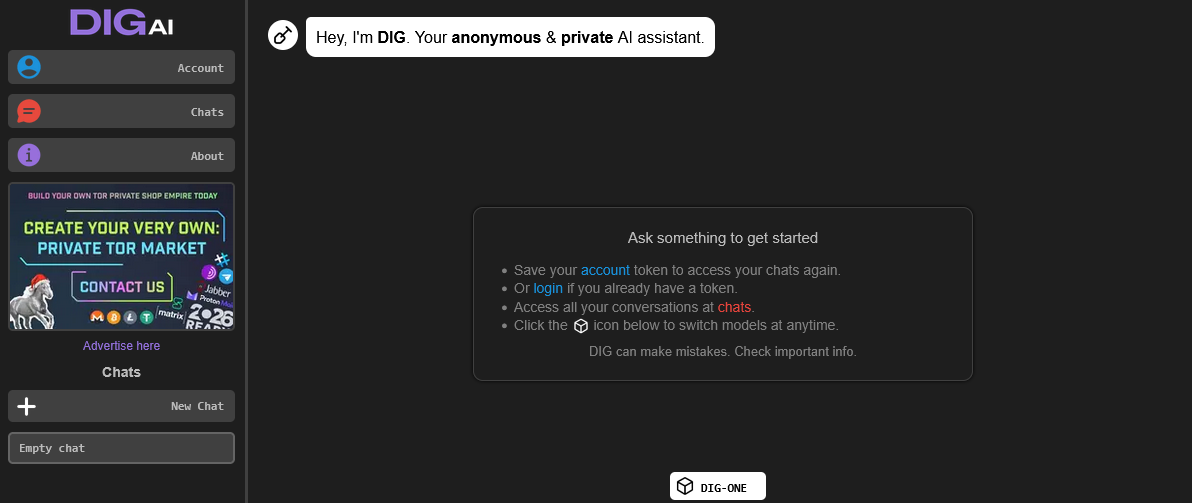
Digai DarkWeb AI assistent , the first AI assistant specifically tailored for the dark web. Digai operates similarly to conventional AI assistants like ChatGPT but is uniquely designed to meet the distinct needs and challenges of users navigating this often perilous online environment.
Digai’s primary purpose is to provide users with an intuitive, intelligent interface that facilitates a wide range of activities commonly undertaken in the dark web, such as information gathering, advice on navigating anonymous marketplaces, or facilitating secure communications. Its architecture mimics that of other advanced AI models, employing powerful algorithms to understand user queries and provide relevant responses swiftly and accurately.
One of the vital aspects of Digai is its robust commitment to user privacy. The dark web is notorious for its anonymity, and Digai is crafted to enhance this experience by ensuring that user interactions remain confidential. The assistant employs state-of-the-art encryption methods and operates in a way that minimizes data retention, vital in environments where clandestine operations are paramount. This dedication to user anonymity not only facilitates safer browsing experiences but also builds trust among individuals who rely on Digai’s assistance for sensitive transactions ranging from information exchange to more complex interactions.
Overall, Digai symbolizes a crucial innovation in the dark web ecosystem, merging advanced artificial intelligence capabilities with the implicit necessity of privacy. As users increasingly seek refined tools for navigating the complexities of the dark web, Digai stands out as a forerunner in providing secure, effective, and intelligent support.
Registration and Accessibility: Free AI Assistance for Everyone
Digai stands out for its accessibility, aiming to provide AI assistance to a wide range of users without any financial barriers. This platform allows individuals to engage either as guests or by creating an account, catering to varying levels of user preference concerning privacy and personalization.
Users who opt for guest access can enjoy the benefits of anonymity. This option is particularly appealing for individuals who may have concerns about their privacy on the dark web. Accessing Digai as a guest allows users to interact with the AI assistant without requiring any personal information, thereby ensuring a layer of security and discretion. This approach draws users who wish to remain low-profile while still benefitting from AI capabilities.
On the other side, creating an account on Digai opens up a more tailored experience. Registered users can expect personalized interactions, as the AI assistant learns from previous engagements to better cater to individual needs. An account also enables users to store preferences and revisit prior queries with ease. While the registration process does require some basic information, it is straightforward and designed to maintain user privacy as much as possible.
Importantly, Digai remains completely free of charge. This commitment significantly lowers the entry barrier for users unfamiliar with AI technology, encouraging a broader audience to explore its functionalities. The free nature reinforces the platform’s mission of democratizing access to advanced AI tools, empowering users within the often obscured realms of the dark web. By offering both guest access and a registered experience, Digai bridges the gap between anonymity and personalization, making AI assistance more accessible to everyone.
Navigating the Dark Web with DigAI DarkWeb AI assistent
Digai stands out as a remarkable AI assistant designed specifically for users exploring the often daunting dark web. Its features are tailored to ensure both efficient information retrieval and enhanced safety for those venturing into this uncharted territory. One of the primary capabilities of Digai is its sophisticated search functionality, which enables users to sift through vast amounts of data across various hidden forums, marketplaces, and social platforms. Rather than the traditional browsing methods, Digai utilizes natural language processing to understand user inquiries and deliver precise results, thus augmenting the research experience.
Moreover, Digai offers personalized assistance by learning from user interactions. This adaptability allows it to suggest relevant resources or further information tailored to each user’s specific needs. For instance, a researcher investigating cybercrime can utilize Digai to access targeted content while filtering out unrelated data, ultimately saving valuable time and effort.
Additionally, safety while browsing the dark web is a significant concern, and Digai addresses this with features tailored to protect user anonymity and security. It can alert users to potential risks, such as malicious websites or phishing attempts, allowing them to navigate the web with enhanced vigilance. The tool can also recommend secure browsing practices and privacy-preserving technologies, ensuring that users minimize exposure while engaging with sensitive information.
Real-life scenarios further illustrate Digai’s capabilities; for example, a journalist might use the AI to explore whistleblowing platforms to gather information about corporate misdeeds. Digai can streamline the process, directing them to credible sources, aggregating opinions, and clarifying complex data. This practical utility showcases how Digai empowers users to traverse the dark web effectively while prioritizing their safety.
The Future of AI Assistants on the Dark Web: DigAI DarkWeb AI assistent
The emergence of AI assistants like Digai on the dark web marks a significant development in the landscape of online interactions. These advanced systems create potential opportunities for enhancing user safety and streamlining processes within this often misconstrued segment of the internet. One of the primary advantages lies in navigating the complexities of dark web forums and marketplaces. AI can assist users in finding legitimate vendors by analyzing data patterns, thereby reducing risks associated with scams and fraudulent activities.
Moreover, AI technology can offer personalized assistance, including tailored content recommendations and efficient communication with other users. This personalization could lead to improved user experiences, fostering a sense of community while maintaining anonymity, which is critical for dark web users.
However, the integration of AI assistants in this unregulated ecosystem raises significant challenges. Ethical considerations abound, as the same technology that enhances safety can also be manipulated by malicious actors. For instance, cybercriminals could exploit AI’s capabilities to automate scams or develop more sophisticated weapons of misinformation. This duality emphasizes the importance of establishing ethical frameworks to govern the use and development of AI technologies in such volatile environments.
In conclusion, the future of AI assistants like Digai offers a promising yet cautionary tale of opportunities and challenges. While there are clear advantages to enhancing user experience and safety, it is imperative that steps are taken to mitigate the ethical implications and risks associated with their use in dark web contexts. As technology advances, ongoing dialogue and proactive measures will be crucial to navigate this intriguing frontier responsibly.